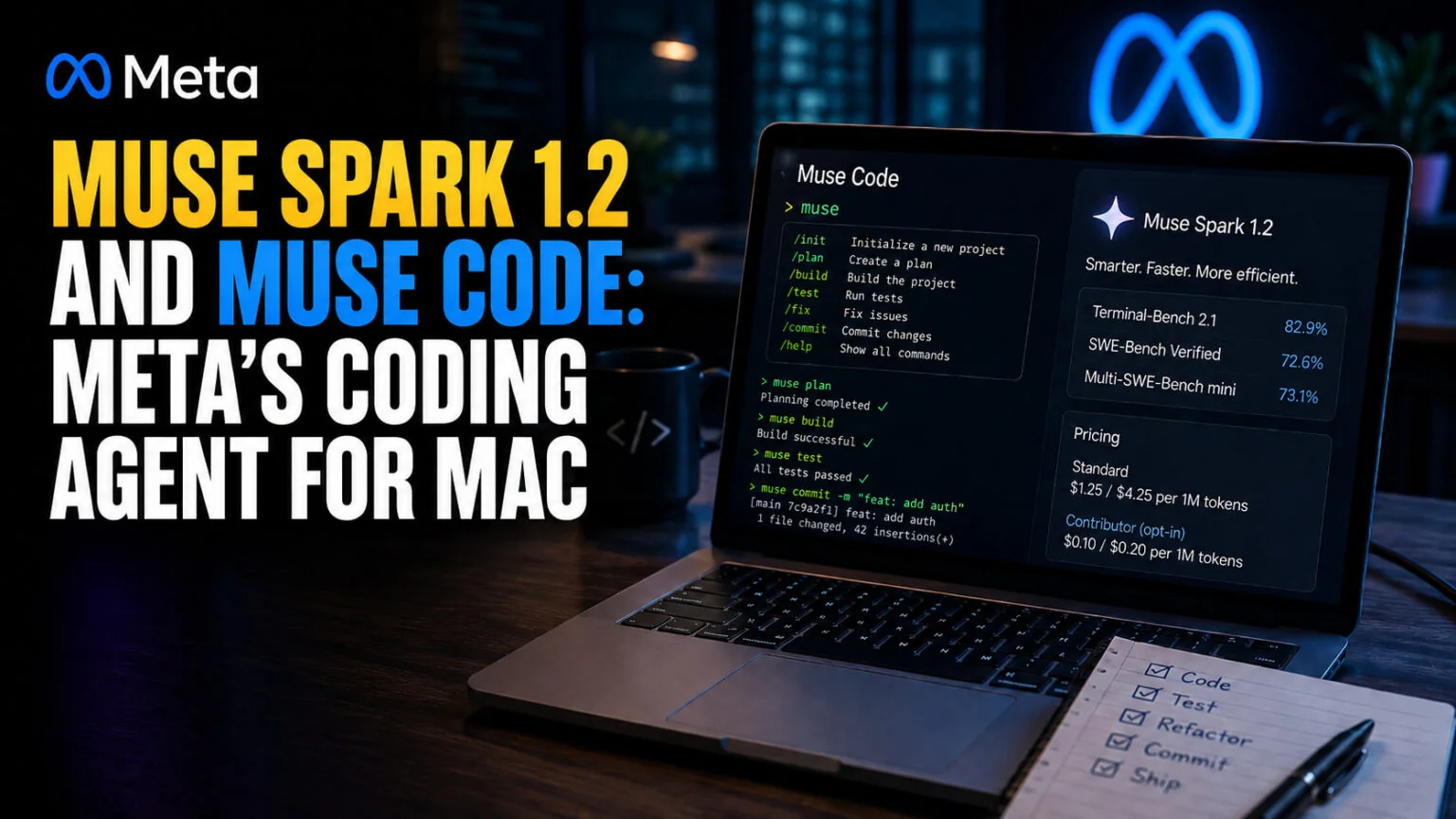
Meta shipped Muse Spark 1.2 on 5 August 2026 alongside Muse Code, its first terminal coding agent, and the launch charts tell a more honest story than the headlines do. On Meta’s own benchmarks, Muse Spark 1.2 loses to Claude Opus 5 on all three coding tests it published, scoring 82.9% to Opus 5’s 86.7% on Terminal-Bench 2.1. What Meta did win on is price, and that is where this release actually matters.
This guide covers what changed in Muse Spark 1.2, why three different benchmark houses report three different scores for it, and what Muse Code is like as a Mac tool. We also verified Meta’s install command ourselves and found that one widely shared version of it points at a domain that does not exist.
The Key Takeaways
- Muse Spark 1.2 launched 5 August 2026 with Muse Code, a terminal coding agent for macOS and Linux. There is no desktop app.
- On Meta’s own charts it trails Claude Opus 5 on all three coding benchmarks, including 82.9% versus 86.7% on Terminal-Bench 2.1.
- Pricing is unchanged from 1.1 at $1.25 input and $4.25 output per million tokens, with a 1M token context window.
- The new Contributor tier drops input to $0.10 and output to $0.20, roughly 92% cheaper, in exchange for letting Meta train on your prompts and completions.
- Muse Code has no subscription. You pay per token, while Claude Code sits inside a $20 plan and Codex inside $20 ChatGPT Plus.
What Is Muse Spark 1.2?
Muse Spark 1.2 is Meta Superintelligence Labs’ coding-focused update to Muse Spark 1.1, which shipped on 9 July 2026. It is Meta’s third model in four months, following the original release in April. Meta describes it as available “today in Muse Code and in Meta Model API with expanded global access”, which matters because Muse Spark 1.1 was limited to a US-only preview.
The headline number is the Artificial Analysis Intelligence Index, where Muse Spark 1.2 scores 54 at its highest reasoning setting, up from 51 for 1.1 and 43 for the April release. That is an 11-point climb in four months, which is a fast improvement curve. It still sits below Claude Opus 5 at 61 and GPT-5.6 Sol at 59.
The model keeps the 1 million token context window from 1.1 and was co-trained with the Muse Code harness itself, which Meta says is why the two work well together. Almost all of the gain is concentrated in agentic work rather than raw knowledge.
Where the gains actually landed
Artificial Analysis broke down the three-point index gain, and it is lopsided. The GDPval-AA v2 agentic score jumped from 1371 to 1631 Elo. That is a 260-point move. Terminal-Bench v2.1, by contrast, rose only from 78% to 80%, and τ³-Banking crept from 25 to 27.
That improvement is not free. Artificial Analysis measured the cost per benchmark task rising from $0.29 on 1.1 to $0.40 on 1.2, with input tokens up around 53% and output tokens up around 36%. The per-token price did not move, but the model deliberates longer, so the same job bills more.
Muse Spark 1.2 Benchmarks, and Why Three Sources Disagree
This is the part most coverage gets wrong. There is no single Terminal-Bench score for Muse Spark 1.2, because at least three organisations measured it and got different answers. Treat any article quoting one number in isolation with suspicion.
Three houses, three answers.
| Source | Terminal-Bench 2.1 result | What it means |
|---|---|---|
| Meta (own evaluation) | 82.9% | Second place behind Opus 5 in Meta’s chart |
| Artificial Analysis | 80% | Independent harness, up from 78% for 1.1 |
| Vals | 14th overall | Common-harness ranking, but 5th on the Vals Index at $0.69 per test |
The Vals result is the most interesting one, because it splits capability from value. Ranked purely on capability Muse Spark 1.2 comes 14th, but ranked on the Vals Index, which weighs cost, it climbs to 5th at $0.69 per test. That is the whole Muse Spark pitch in one line.
How it compares on Meta’s own charts
Meta published three coding comparisons at launch, and Muse Spark 1.2 comes second on every one of them. We think that is worth stating plainly, because a vendor publishing charts it loses on is unusual, and it tells you where the model really sits.
| Benchmark | Muse Spark 1.2 | Claude Opus 5 | Codex (GPT-5.6 Terra) |
|---|---|---|---|
| Terminal-Bench 2.1 | 82.9% | 86.7% | 81.8% |
| DeepSWE 1.1 | 59.3% | 65.0% | 64.8% |
| Meta Internal Coding Bench | 70.6% | 79.4% | Not published |
The DeepSWE gap is the one to watch. Muse Spark 1.2 sits nearly six points behind both Opus 5 and Codex there, and DeepSWE measures exactly the long-horizon agentic coding that Muse Code is built for. On raw terminal tasks it is competitive; on sustained multi-file work it is not yet.
What Is Muse Code?
Muse Code is Meta’s terminal coding agent, released in beta for macOS and Linux. It plans changes, writes code and validates the results across large repositories, and it runs entirely in your terminal. There is no GUI, which is the clearest difference from Claude Code’s desktop and IDE surfaces.
Three architectural choices set it apart. It keeps persistent background sub-agents alive for the whole session rather than spawning a new one per task. It uses worktree isolation so parallel agents do not collide. And it writes an append-only local event log recording every model call, tool run, approval and edit.
That event log is the novel bit. Because every action is appended in order, the runtime is replay-exact and restart-safe, so after a crash the agent resumes precisely where it stopped rather than starting the task again. If you have ever lost forty minutes of agent work to a dropped connection, you will understand why that matters.
The built-in commands
The workflow is approval-gated and built around three commands. /plan turns your objective into a plan you approve before a single line of code changes. /grill then attacks that plan, challenging migration order, missing tests, rollback steps and security boundaries. /goal executes.
Plan, grill, execute, then read the diff and test results yourself. Meta has made no production guarantees here. A beta agent editing a real repository still needs a human checking what it did.
How to Install Muse Code on Mac
Meta documents a single install command for macOS in its launch post, and the installer places a muse launcher in ~/.local/bin. You will also need Meta Model API credentials, since the agent bills per token rather than through a subscription.
curl -fsSL https://dev.meta.ai/install.sh | bashOne warning worth taking seriously. Several guides circulating since launch print this command with the domain dev.meta.com instead of dev.meta.ai. We checked, and dev.meta.com has no DNS record at all, so that version cannot work for anyone. Meta’s own post uses dev.meta.ai, which resolves to Meta infrastructure.
We also probed the endpoint directly from Europe. A deliberately fake path on that host returns a clean 404, while /install.sh returns a 500. That points to a real path that is either erroring or region-gated, not a missing one. If the command fails for you, that is the likely reason. Retry it before assuming you mistyped it.
As always, piping a remote script straight into your shell runs whatever that script contains. Read it first if you are installing on a work machine.
Muse Code vs Claude Code vs Codex
All three are terminal agents aimed at long repository work, and the real difference is how you pay and how mature they are. Muse Code is a first-generation beta; the other two have been shipping for much longer.
| Agent | Model | Terminal-Bench 2.1 | How you pay | Platforms |
|---|---|---|---|---|
| Muse Code | Muse Spark 1.2 | 82.9% | Per token, no subscription | macOS, Linux |
| Claude Code | Claude Opus 5 | 86.7% | Inside $20 Pro, Max at $100 and $200 | Terminal, IDE, desktop, web |
| Codex | GPT-5.6 Terra | 81.8% | Inside $20 ChatGPT Plus | App, IDE, CLI, cloud |
| Grok Build | Grok 4.6 | 88.4% | X Premium tiers | CLI |
The pricing models are not comparable in the way the raw numbers suggest. With Claude Code and Codex, heavy usage is absorbed by a flat monthly fee. With Muse Code, a long agentic session on a large repository bills every token it burns, and Muse Spark 1.2 burns more tokens per task than 1.1 did.
Pricing and the Contributor Tier Catch
Standard pricing is unchanged from Muse Spark 1.1, which is itself notable given the capability bump. You pay $1.25 per million input tokens, $0.15 per million cached input tokens and $4.25 per million output tokens. Web search grounding costs $2.50 per 1,000 queries.
Then there is the second tier, and this is the part that deserves more attention than it has had. The Contributor tier charges $0.10 per million input tokens and $0.20 per million output, roughly 92% cheaper on input and 95% cheaper on output.
The Contributor discount is not a promotion. You get it by granting Meta permission to train future models on your prompts and completions, which on a coding agent means your codebase.
For a hobby project or open-source work, that trade is fine. For a private repository, client code or anything under an NDA, it is not a pricing decision at all, it is a data governance one. Read your employment contract before you pick the cheap tier.
Should You Switch to Muse Spark 1.2?
Not as your primary agent, not yet. Muse Code is a beta from a first-time entrant, and by Meta’s own measurements the model behind it comes second on every coding benchmark it published. Claude Code and Codex have longer track records and larger ecosystems.
Test it, do not standardise on it.
Three situations make it worth testing. If your workload is high-volume and cost-sensitive, the standard tier is meaningfully cheaper than Sonnet 5 per token. If you work on open-source code where training rights are not a concern, the Contributor tier is the most aggressive pricing from any capable coding model.
The third is narrower but real. If you have been burned by agents losing state mid-task, the crash-safe event log is an engineering advantage neither competitor matches.
For a wider view of where Meta sits against everyone else, see our guide to the best AI models available today. Our breakdown of the original Muse Spark model covers how this family started.
Want Every Top AI Model in One App?
Muse Code is built for developers who live in a terminal and are comfortable managing API keys and metered billing. Most people are not, and juggling separate apps, credentials and credit balances for each model gets old fast.
Fello AI puts the leading models, including Claude, ChatGPT, Gemini, Grok and DeepSeek, together in one clean Mac app. You compare answers and pick the best tool for each task without managing keys or credits. It runs on Mac, iPhone and iPad, starting at $9.99 a month.
Conclusion
Muse Spark 1.2 is a real improvement over 1.1, and Muse Code is a more thoughtful first agent than most vendors ship. But Meta published charts showing its own model in second place, and the independent numbers are less flattering still, so the honest read is that this competes on price rather than capability.
If you are cost-sensitive and your code can tolerate the Contributor terms, install it and run a bounded task through /plan and /grill before trusting it with anything important. If you are already productive in Claude Code or Codex, there is no reason to move yet.
FAQ
Is Muse Code free?
The Muse Code CLI is free to install, but the model usage is not. There is no subscription tier at all. You pay per token through the Meta Model API, at $1.25 per million input tokens and $4.25 per million output on the standard plan.
Is Muse Spark 1.2 better than Claude Opus 5?
No, and Meta’s own charts show it. Muse Spark 1.2 scores 82.9% on Terminal-Bench 2.1 against Opus 5’s 86.7%, 59.3% on DeepSWE 1.1 against 65.0%, and 70.6% on Meta’s internal coding benchmark against 79.4%. It competes on price rather than peak capability.
Does Muse Code run on Windows?
Not at launch. Meta published install instructions for macOS and Linux only, and there is no native Windows installer documented in the launch post. Windows users would need WSL, which Meta has not confirmed as supported.
Does Meta train on my code?
Only if you choose the Contributor tier. That tier costs $0.10 per million input tokens and $0.20 per million output, around 92% less than standard. The discount is granted in exchange for permission to train future Meta models on your prompts and completions. The standard tier carries no such condition.
What context window does Muse Spark 1.2 have?
One million tokens, unchanged from Muse Spark 1.1. That is roughly 1,500 pages of formatted text, which is what allows Muse Code to hold large repositories in context during long agentic sessions.