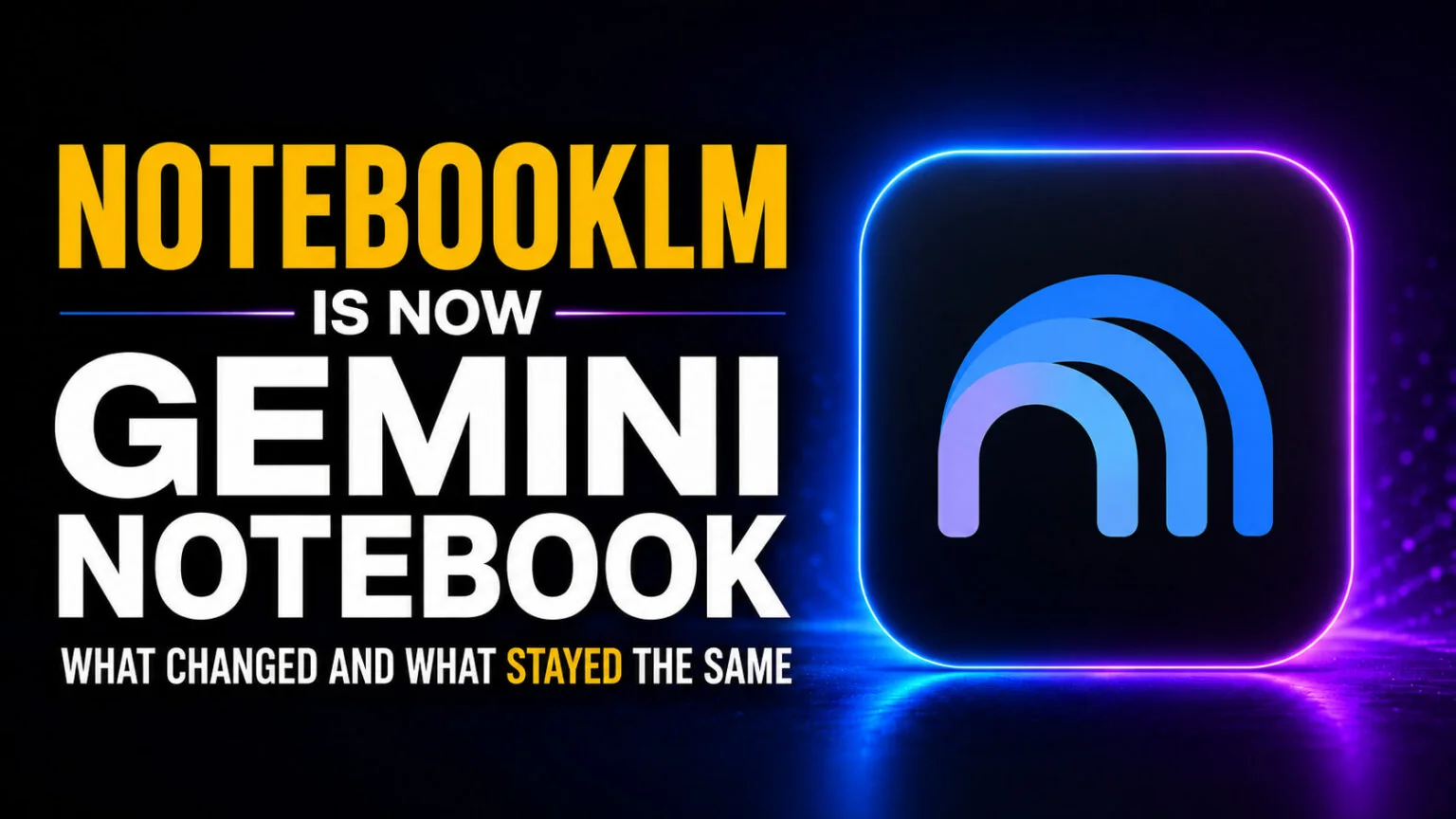
On July 16, 2026, Google renamed NotebookLM to Gemini Notebook, folding its popular research tool into the wider Gemini brand. If you woke up to a new blue-purple logo and a different name at the top of your screen, nothing is broken and nothing is gone. It is the same product, at the same address, with your notebooks exactly where you left them. To see which Gemini models now sit behind the tool and how the lineup compares, read our Gemini model comparison.
The change matters because NotebookLM was not a niche experiment; it had grown to 30 million users and more than 600,000 organizations before the rename. This article breaks down what actually changed, what stayed the same, the one new feature that shipped alongside the new name, and whether you need to lift a finger. We also clear up the confusion between the standalone Gemini Notebook app, the “Notebooks” section inside the Gemini chat app, and Gems, because those are three different things. And if you arrived here searching for Gemini NotebookLM or Gemini Notebook LM, that hybrid is not a Google name at all; it is simply what people type while two names are in circulation at once.
The Key Takeaways
- NotebookLM is now Gemini Notebook, effective July 16, 2026. It is a rename, not a shutdown.
- Everything transfers automatically. The site notebooklm.google.com still works, shared links redirect, and all your notebooks and Audio Overviews stay put.
- The free tier is unchanged. Paid Google AI Pro and AI Ultra plans continue as before.
- One real new feature ships with the rename: a secure cloud computer in every notebook that can write and run code for data analysis.
- Gemini Notebook, the Gemini app and Gems are three different things. The rollout is staged, so you and a colleague may still see different names this week.
What Google Actually Changed
The short version is that NotebookLM got a new name, a new logo, and one new capability, and almost everything else stayed identical. In its official announcement, Google said it “remains a standalone product focused on being your premier research tool,” now doing more across the Google ecosystem. This is the product’s third name, having started life as Project Tailwind before becoming NotebookLM, and now Gemini Notebook.
The most important thing to understand is that this is a rebrand, not a discontinuation. Your existing notebooks did not move, your shared links keep working through automatic redirects, and browser extensions built for NotebookLM continue to function. The table below shows the full before-and-after at a glance.
| Aspect | Before (NotebookLM) | Now (Gemini Notebook) |
|---|---|---|
| Name | NotebookLM | Gemini Notebook |
| Logo | Old NotebookLM mark | Blue-purple Gemini gradient |
| Website URL | notebooklm.google.com | notebooklm.google.com (unchanged) |
| Existing notebooks | Yours | Same, carried over automatically |
| Shared links | Working | Working, auto-redirect |
| Free tier | Available | Unchanged |
| Audio & Video Overviews | Yes | Yes |
| Code execution | No | New secure cloud computer |
| Gemini app & Search links | Notebooks in Gemini (April 2026) | Deeper, with Search AI Mode planned |
If you use Gemini Notebook the way most people use it, for turning documents into summaries, Audio Overviews, and mind maps, your day-to-day workflow does not change at all. The rename is mostly cosmetic for existing users. The one exception is the new code feature, which we cover next.
NotebookLM vs Gemini Notebook: Are They the Same Thing?
Yes. There is no “versus” here, and that is the whole answer. Gemini Notebook is NotebookLM with a different name and logo. There is no second product, no migration, no old version left running somewhere, and no feature that was taken away in the swap. If you are comparing the two, you are comparing one thing to itself.
The reason so many people are searching for a difference is that Google has not finished changing the name everywhere. Its own help centre is currently split down the middle: the newer Gemini Notebook help pages use the new name throughout, while the Gemini Apps help pages still say “NotebookLM” in their body text. Google told Workspace admins the rollout is an extended one, potentially running longer than 15 days for the new name and logo to appear across every interface.
That is why the two names coexist in the wild right now, and why you may see the old branding on your phone and the new branding on your laptop on the same day. Neither is wrong. It also explains the hybrid phrases; Gemini NotebookLM and Gemini Notebook LM appear nowhere on Google’s own sites, but they are a reasonable thing to type when you have seen both names and are not sure which one stuck.
The One New Feature: A Secure Cloud Computer in Every Notebook
The rename did not arrive empty-handed. Alongside the new brand, Google gave every notebook a secure cloud computer that can write and run code natively, letting Gemini Notebook perform complex data analysis grounded in your own sources. Instead of only summarizing your documents, the tool can now crunch numbers, build charts, and reason over data files inside the notebook itself.
This is the same kind of code-execution sandbox that power users have wanted for structured data. Upload a spreadsheet or dataset, and the notebook can analyze it directly rather than just describing what it contains. For research-heavy work, that turns Gemini Notebook from a reading assistant into something closer to a lightweight analyst.
Who Gets the Cloud Computer First
The code feature is rolling out in stages rather than to everyone at once. At launch it went live for Google AI Ultra subscribers and Workspace business customers with the right access tiers. Google says it will reach Google AI Pro users on the web “over the coming weeks.”
Google has not said the cloud computer is coming to the free tier, so treat it as a paid-tier capability for now. If you rely on Gemini Notebook’s free plan, your familiar features remain intact, but the new code execution is not part of that free experience at the time of writing. For a fuller breakdown of where the paid ceilings sit, see our look at Google’s Gemini 3.5 and its plans.
Gemini Notebook vs “Notebooks in Gemini”
Here is where most people get confused, so let us be precise. There are now two things with almost the same name, and they are not identical. Understanding the difference saves you from hunting for a feature in the wrong place.
The Standalone Gemini Notebook App
This is the full product, the one formerly called NotebookLM, living at its own address. It holds the complete feature set, including Video Overviews, Deep Research, Mind Maps, and now the secure cloud computer. If you want everything Gemini Notebook can do, this is where you go.
The “Notebooks” Section Inside the Gemini App
On April 8, 2026, months before the rename, the Gemini chat app gained a “Notebooks” section that lets you start a research project without leaving Gemini. It launched to paid subscribers on the web, reached free accounts later that month, and arrived on mobile at the end of April. It shares the same notebooks as the standalone app, and Google confirms the sync runs both ways: rename a notebook, add sources or change custom instructions in one app, and the change appears in the other. Deleting a notebook in one deletes it in both.
What the Gemini App Cannot Do
The in-app section is deliberately lighter. Google states plainly that Gemini “will not have the ability to generate items from the Gemini Notebook Studio panel,” which covers Audio Overviews, Video Overviews, infographics and slide decks. Anything you make in the Studio panel needs the standalone app.
Three more limits catch people out. Shared notebooks never appear in the Gemini app, even ones you own. A notebook created inside Gemini cannot use another notebook as a source. And the feature requires a personal Google account, so work and school accounts are excluded.
How to Open a Notebook Inside the Gemini App
There is no button to press and nothing to connect. This is the part people search for most and it does not exist, because Google made the link automatic: notebooks you create in Gemini Notebook simply appear in Gemini’s navigation, and notebooks you create in Gemini appear in the standalone app. What you actually do is start one from whichever side you happen to be on.
On the web, go to gemini.google.com, click Open Sidebar at the top left, then New notebook, name it, and enter a prompt. You can click sources to attach files. On Android and iOS, tap Menu at the top left, then under Notebooks tap New notebook. Existing notebooks sit under All Notebooks.
One regional catch. If you are in the EEA, the UK or Switzerland, Gemini asks for explicit permission before it will create and sync notebooks between the two products, so the section stays empty until you grant it.
Why Google Renamed NotebookLM
The old name carried a piece of engineering jargon that meant little to normal people. “LM” stands for language model, and Google decided that most of its 30 million users neither knew nor cared what that meant. Dropping it in favor of the Gemini brand makes the product instantly legible as part of Google’s AI family.
This is also a pattern, not a one-off. TechCrunch called it Google’s “renaming streak”, and it fits. The company has spent the past two years consolidating its AI products under the Gemini umbrella, first turning Bard into Gemini, then rebranding Duet AI in Workspace. Pulling NotebookLM into the same house was the logical next step. The blue-purple gradient logo now signals, at a glance, that this is a Gemini product.
Gemini Notebook vs Gems: What Is the Difference?
Gems are the third thing people mix up with notebooks, and the distinction is simpler than it looks. A Gem is a saved set of instructions that changes how Gemini behaves, a custom persona you can reuse. A notebook is a container of sources that Gemini answers from. One shapes the voice, the other supplies the facts.
The practical difference is grounding. Inside Gemini Notebook, answers come only from your sources, with in-line citations you can click to check. A Gem keeps Gemini’s full range, including web search, and treats any knowledge files you add as helpful context rather than a hard boundary. If you need every sentence traceable to a document you uploaded, that is a notebook, not a Gem.
| Gemini Notebook | Gems | |
|---|---|---|
| What it is | A workspace built around your sources | A reusable custom persona for Gemini |
| Grounding | Only your sources, with citations | Full Gemini, including web search |
| Files | Up to 500,000 words or 200MB per source | Optional knowledge files, Drive files, code repos |
| Studio outputs | Audio and Video Overviews, mind maps, slide decks | None |
| Sharing | Share a notebook, but shared ones stay out of the Gemini app | Share the Gem or a conversation using it |
| Works with the other | Can be attached to a Gem as knowledge | Cannot be used with Gemini Live |
The two are not rivals, and this is the part most comparisons miss: a Gem can pull in a notebook. When you build a Gem, click More uploads and then Notebooks to attach one as its knowledge base. That gives you a persona with a defined instruction set sitting on top of a curated source library, which is the closest thing to having both at once.
Do You Need to Do Anything?
For almost everyone, the answer is no. You do not need to migrate, re-import, or re-share anything. Google handled the transition on its end, and the automatic redirects mean old bookmarks and shared notebook links keep resolving to the right place.
If you have shared a notebook link with colleagues or students, it still works, so there is no need to resend anything. If you use a browser extension built for NotebookLM, it keeps functioning, since the underlying site did not move. The only new thing to explore is the code feature, and only if you are on a paid plan that has received it. Beyond that, you can carry on exactly as before. If you are weighing which assistant fits which job, our guide on when to use which AI tool puts Gemini Notebook in context alongside the alternatives.
What This Means Going Forward
Gemini Notebook remains the best free way to turn your own documents into summaries, study aids, and Audio Overviews, and the rename does not take any of that away. What changes is the trajectory. By pulling the tool under the Gemini brand and wiring it into the Gemini app and, soon, Google Search’s AI Mode, Google is signaling that notebooks are becoming a core part of how you research across its products, not a side project. If you are checking what the free plan still includes after the rename, see is NotebookLM free.
For now, the practical takeaway is simple. Nothing you rely on has disappeared, the free tier is intact, and there is a powerful new code feature waiting for paid users. Nothing moved on the invoice either, as our breakdown of NotebookLM pricing across Free, Plus, Pro and Ultra lays out. If you want the full background on how the tool works, our explainer on what NotebookLM is and how it works walks through the core features under their new name. And if you like the idea of running several AI models from one place, Fello AI brings the leading models together on your Mac so you can research, write, and create without juggling tabs.
FAQ
Is Gemini Notebook the same as NotebookLM?
Yes. Gemini Notebook is simply the new name for NotebookLM as of July 16, 2026. Same product, same address, same notebooks and the same free tier, under the Gemini brand with a new blue-purple logo, plus one new code-execution feature.
Is NotebookLM discontinued?
No. NotebookLM was not discontinued, it was renamed. The website still works, shared links redirect automatically, and all your notebooks and Audio Overviews stay exactly as they were.
What is Gemini NotebookLM?
It is not an official product name. Google uses “Gemini Notebook”, and the hybrid forms “Gemini NotebookLM” and “Gemini Notebook LM” appear nowhere on Google’s own sites. People type them because both names are still circulating during the rollout. They refer to the same tool.
What is Notebook LM in the Gemini app?
It is the “Notebooks” section Google added to the Gemini chat app on April 8, 2026. It shares your notebooks with the standalone Gemini Notebook and syncs both ways, but it cannot generate Studio items such as Audio or Video Overviews.
How do I connect NotebookLM to Gemini?
You do not have to. The two are linked automatically, so notebooks created in either place appear in the other. Just open the sidebar in Gemini and pick New notebook. In the EEA, the UK and Switzerland you must first grant Gemini permission to create and sync notebooks.
What is the difference between Gemini Notebook and Gems?
A notebook answers only from the sources you upload and cites them. A Gem is a reusable custom persona that keeps Gemini’s full abilities, including web search. You can combine them by attaching a notebook to a Gem through More uploads, then Notebooks.
Is Gemini Notebook still free?
Yes. The free tier continues unchanged after the rename, with 100 notebooks, 50 sources each and 50 chats a day. Paid Google AI Pro and Ultra plans remain available, and the new secure cloud computer is reaching paid tiers first.
Will my notebooks and shared links still work?
Yes. Every existing notebook carries over automatically and notebooklm.google.com still works. Shared links redirect on their own, so you do not need to resend anything to colleagues or students.