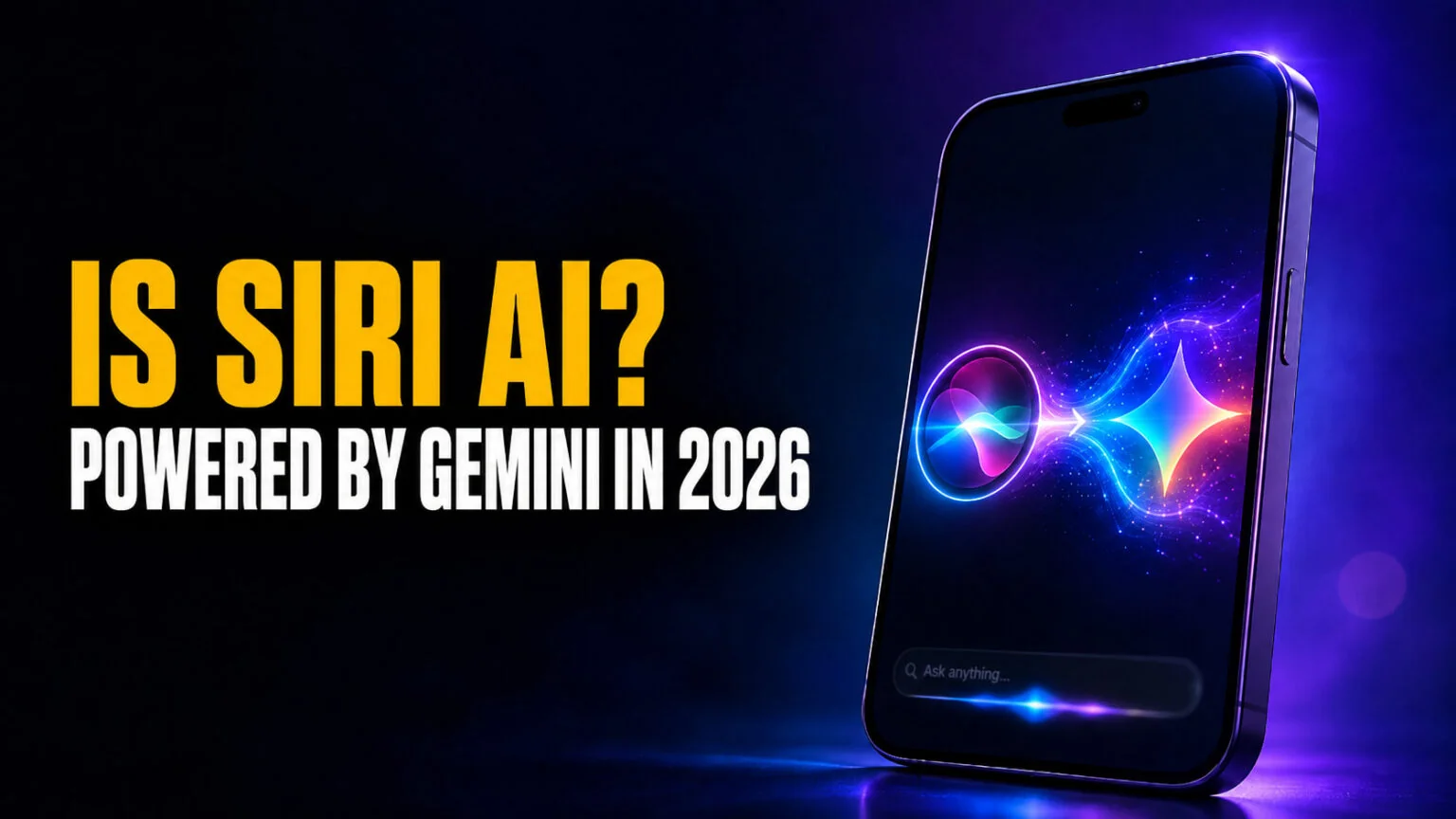
Yes, Siri is AI, but a limited kind. Since it launched on the iPhone 4S in October 2011, Siri has run on narrow AI. That means speech recognition, natural language processing, and machine learning tuned for specific tasks like setting timers, sending texts, and answering quick factual questions. It does not reason, hold a flowing conversation, or write you an essay the way ChatGPT, Claude, or Gemini do. So when you say “Hey Siri,” you are talking to real artificial intelligence, just an older and narrower version of it.
That definition just changed in a big way. At WWDC on June 8, 2026, Apple unveiled Siri AI, an entirely new version of the assistant rebuilt as a full AI chatbot powered by Apple Intelligence. The public beta arrived on 13 July 2026 and the finished version ships with iOS 27 and macOS 27 in September 2026. This article covers what kind of AI Siri uses today, what Siri AI actually runs on, and why it will not reach every device in every country at the same time. It also explains how the Apple-Google deal works, what it means for your privacy, and how the new Siri stacks up against the chatbots you already use.
If Siri ever stops responding on your iPhone, our guide on why Siri is not working walks through the fixes, and if you want to try the rebuilt assistant yourself, how to set up Siri covers enabling it on every device. That choice matters more than it looked at the time, because Apple and OpenAI are now in court over alleged trade secret theft.
The Key Takeaways
- Siri is AI, but it runs on narrow AI built for set tasks, not the open-ended generative AI behind ChatGPT, Claude, and Gemini.
- Apple unveiled Siri AI, a full AI chatbot for iOS 27, iPadOS 27, and macOS 27, at WWDC on June 8, 2026. It has been in public beta since 13 July 2026, with the full release in September 2026.
- Siri AI runs on Apple Foundation Models, which Apple built using Google Gemini technology under a multi-year deal announced on 12 January 2026. Apple, not Google, still runs the models.
- In the EU, Siri AI works on Mac and Vision Pro but not on iPhone, iPad, or Apple Watch at launch. It is not available in China.
- Apple agreed to a $95 million settlement in the Lopez v. Apple Siri eavesdropping case, with payouts that began in January 2026.
Is Siri AI? The Short Answer
Siri is artificial intelligence, but it sits at the basic end of the scale. Engineers call this narrow AI, sometimes called weak AI, meaning a system trained to do a small set of jobs very reliably rather than think broadly. Siri recognizes your voice, figures out roughly what you want, and triggers a matching action. It is real AI, just not the conversational, reasoning kind that dominates headlines today.
The confusion comes from how fast the meaning of “AI” has shifted. When Siri arrived in 2011, a phone that understood spoken commands felt futuristic. After the rise of large language models (LLMs), the same Siri feels stiff and scripted by comparison. Both things are true at once, Siri is AI, and Siri is far behind the chatbots that came later.
Narrow AI vs Generative AI
The gap between Siri and a tool like ChatGPT is the gap between narrow AI and generative AI. Narrow AI matches your request to a known pattern and runs a fixed action, which is why old Siri often replied “Here’s what I found on the web” when a question went off-script. Generative AI is built on large language models trained on enormous amounts of text, so it can reason through a problem, write original content, and keep track of a long back-and-forth.
Old Siri was excellent at the narrow stuff, timers, reminders, calls, basic facts, and weak at everything open-ended. The 2026 rebuild is Apple’s attempt to close that gap by putting a real generative model underneath the assistant you already know.
How Does Siri Work Today?
Under the hood, today’s Siri runs a short pipeline every time you talk to it. Understanding those steps makes it clear why the assistant has always felt more like a command tool than a conversation partner.
- Siri captures your voice and converts the speech to text using machine learning models trained on millions of audio samples.
- It interprets what you meant with natural language processing, matching your words to an intent it knows how to handle.
- It runs the action either on-device or through Apple’s cloud, then speaks or shows the result.
Since iOS 15, a lot of this happens on-device, which is faster and keeps more of your audio on your iPhone. The limitation was never the plumbing, it was the brain. Old Siri had no large language model behind it, so anything outside its known intents fell flat.
What Is the New Siri AI?
The 2026 version of Siri is a different animal. Apple rebuilt the assistant as a full conversational chatbot that you can talk to in a back-and-forth thread, much like ChatGPT’s voice mode. At WWDC, Apple showed off a standalone Siri app where you can revisit past conversations or start a new one, with history synced across your devices through iCloud. The new Siri AI answers questions about what is on your screen, searches your own messages, emails, and photos, pulls in current web knowledge, and runs systemwide app actions across your apps in a single request, building on the same Siri Shortcuts system power users already rely on. If you want to personalize how it sounds, see our guide on how to change Siri’s voice.
The engine behind those cloud features is the next generation of Apple Foundation Models, which Apple developed using the technology behind Google’s Gemini models. That distinction matters. Apple did not bolt Gemini onto Siri; it used Google’s models as the foundation for its own, and Apple still serves them. Bloomberg reported before the launch that the custom model runs roughly 1.2 trillion parameters on a mixture-of-experts design, a figure neither company has confirmed.
It is a sharp reversal for a company that spent years arguing people should not have to go “off into some chat experience” to get things done. Chatbots simply got too useful, and too popular, for Apple to keep sitting them out.
Apple unveiled the rebuilt Siri at WWDC on June 8, 2026. The public beta of iOS 27, iPadOS 27, and macOS 27 “Golden Gate” went live on 13 July 2026 with Siri AI as its headline feature, and the finished release lands in September 2026 alongside the new iPhones. If you want the full rundown of everything Apple announced, see our WWDC 2026 recap.
The New Siri App and Dynamic Island
The rebuilt Siri also gets its own home. Apple is adding a dedicated Siri app that keeps every exchange in a scrollable thread of iMessage-style chat bubbles, so a conversation with Siri now reads like a text message thread rather than a one-off command. You can favorite useful chats, search inside past conversations, save them, and start fresh whenever you like, with suggested prompts at the top to show what the assistant can handle.
Siri is also moving into the Dynamic Island. When you fire off a request, a glowing Siri icon and a “searching” label appear in the cutout, then expand into a larger translucent panel once the answer is ready. It is a small touch, but it signals how central Apple now wants the assistant to feel, surfacing answers without pulling you out of whatever app you are in.
The Apple-Google Gemini Deal Explained
Apple is not building this new brain entirely on its own. The two companies confirmed a multi-year partnership in a joint statement on January 12, 2026, under which, in their words, “the next generation of Apple Foundation Models will be based on Google’s Gemini models and cloud technology.” The same statement is explicit that Apple Intelligence keeps running on Apple devices and Private Cloud Compute. Reporting puts the price at roughly $1 billion per year, with the full multi-year deal valued at up to $5 billion, a striking figure given Apple’s long history of building its core technology in-house.
The arrangement is less surprising once you look at where Apple’s own models landed. Rather than ship a weaker home-grown assistant, Apple chose to license one of the strongest models available and wrap it in its own software and privacy layer. For a deeper look at how the major labs stack up, our guide to the best AI models right now breaks down where Gemini, GPT, and Claude each lead.
Will You Be Able to Choose ChatGPT, Gemini, or Claude?
Here is the part most coverage gets wrong. Bloomberg reported in March 2026 that Apple was building an Extensions framework to let you pick which AI handles Siri’s requests, with ChatGPT, Gemini, and Claude as the expected providers. Apple never demonstrated it at WWDC, never mentioned it in the Siri AI press release, and it is still not in the public beta. Treat it as reported and expected at launch, not as something you can switch on today.
We break down everything new in our full iOS 27 features guide.
The catch, if it ships as described, is that you choose one model at a time. Apple’s planned setup treats these powerful chatbots as interchangeable backends, not as a panel you can compare side by side. That is fine if you have a clear favorite, and frustrating if you want the best answer from each model for different jobs.
New Siri vs ChatGPT, Gemini, and Claude
So how does the rebuilt Siri actually compare to the chatbots people already lean on? The table below lines up today’s Siri, the rebuilt Siri AI, and the major assistants on the type of AI they use, what they do best, and whether you can use them right now.
| Assistant | Type of AI | Best at | Full chatbot? | Available now on Mac and iPhone? |
|---|---|---|---|---|
| Today’s Siri | Narrow AI | Timers, calls, quick facts, device control | No | Yes |
| New Siri (iOS 27) | Generative (Apple Foundation Models) | Conversation, web search, images, file analysis | Yes | Public beta now, full release September 2026 |
| ChatGPT | Generative (GPT) | Writing, coding, all-round reasoning | Yes | Yes |
| Gemini | Generative (Gemini) | Research, long context, Google integration | Yes | Yes |
| Claude | Generative (Claude) | Long documents, coding, natural writing | Yes | Yes |
| Fello AI | All of the above | Switching between every model in one app | Yes | Yes |
The honest takeaway is that the new Siri should finally feel competitive once it ships, but it is still months away and still asks you to commit to a single underlying model. If you want a full chatbot on your Mac or iPhone today, the leading assistants are already here. Our ChatGPT vs Gemini comparison is a good place to start if you are weighing the two biggest names.
Where Siri AI Actually Works, and Where It Does Not
This is the part that decides whether any of the above applies to you, and most coverage skips it. Siri AI is English only at launch, it needs an Apple Intelligence device, and it is not shipping everywhere at once. Apple spelled the limits out in the same press release that introduced it.
The regional split is the surprising one, and it cuts in the Mac’s favour. In Apple’s own words, “Mac and Apple Vision Pro users in the EU will be able to access Siri AI,” but “Siri AI will not be available initially in the EU in iOS, iPadOS, and watchOS.” If you are in Europe, that means the rebuilt assistant lands on your MacBook and skips your iPhone. Apple says it is “working hard to find a path forward” on privacy and security, without giving a date.
Siri AI and the rest of the new Apple Intelligence features are not available in China at all while Apple works through local regulatory requirements. On hardware, you need an iPhone 16 or later, an iPhone 15 Pro or 15 Pro Max, or a Mac or iPad with an M1 chip or newer. Our guide to which devices support Apple Intelligence has the full list.
What About Privacy? The Siri Eavesdropping Settlement
Privacy is the first thing many people ask about when Google’s name enters the conversation. The concern is not abstract. Apple agreed to a $95 million settlement in Lopez v. Apple, a long-running case alleging Siri recorded people without the “Hey Siri” trigger and that some audio was shared with third parties. Eligible users could claim up to $20 per Siri-enabled device, capped at five devices, and payouts began landing in January 2026.
That history is exactly why the Google partnership makes some users nervous, and some choose to turn Siri off altogether.
For Siri AI, Apple’s stated approach is to process sensitive requests through Private Cloud Compute, its own encrypted server framework, rather than handing your data to Google outright. Apple’s position is that the models run inside that infrastructure, so your requests are not handed to Google at all. The joint statement commits to exactly that, promising Apple Intelligence “will continue to run on Apple devices and Private Cloud Compute.” The exact technical split between Apple’s servers and Google’s is still being detailed, so it is worth reading the fine print when Apple publishes it. If you want the broader context on how Apple frames its on-device approach, see our breakdown of Apple Intelligence.
What to Use Today If You Want a Real AI Assistant
You do not have to wait until fall to get a genuine AI chatbot on your Apple devices. The major assistants already run on Mac, iPhone, and iPad, and they are far ahead of the Siri you are using right now. The only real friction is that each one lives in its own app with its own subscription, so people end up paying for two or three and juggling tabs.
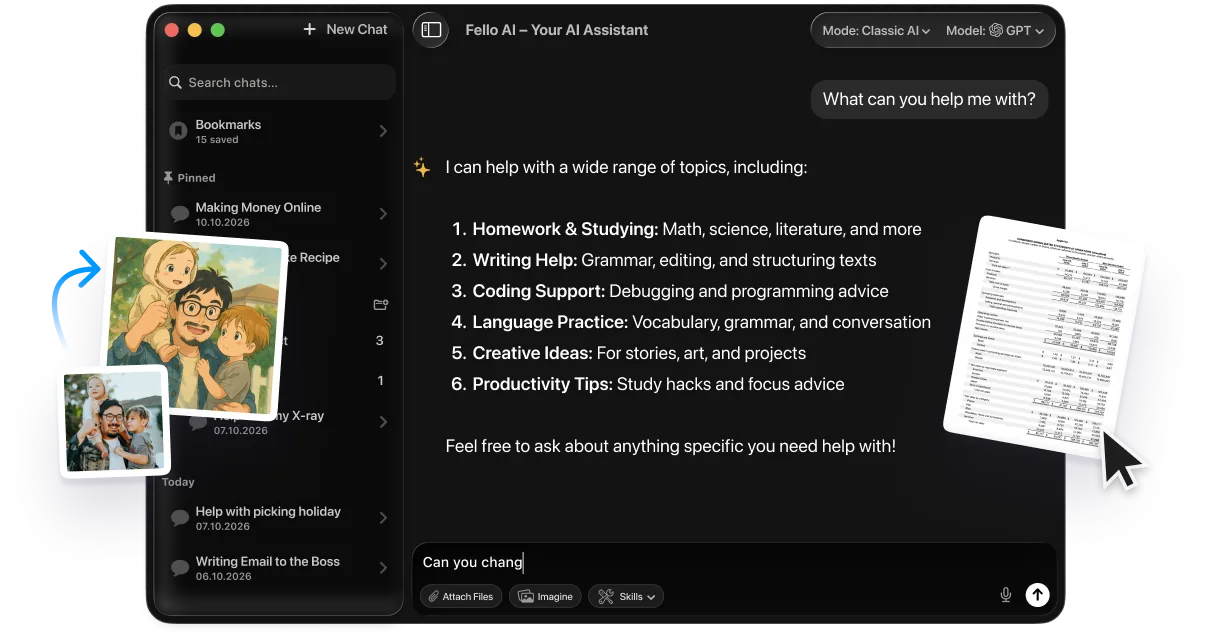
That is the gap Fello AI fills. Instead of locking you into a single model the way Apple’s Extensions setting does, Fello AI puts Claude, ChatGPT, Gemini, Grok, and DeepSeek in one native Mac and iPhone app for one price. You can ask the same question across models, then route each job to whichever model handles it best. No per-app subscriptions to juggle. If you are comparing options, our roundup of the best ChatGPT alternatives for Mac covers the full field.
Conclusion
Siri has always been AI, just the narrow, task-focused kind that now feels dated next to modern chatbots. The 2026 rebuild changes that by putting a new generation of Apple Foundation Models underneath the assistant and turning “Hey Siri” into a real conversation. It is a genuine leap, but the full release is still weeks away, it skips the iPhone entirely in the EU, and the promised option to swap in another chatbot has not appeared yet. If you want to get more from the assistant right now, see our guide on how to use Siri.
If you want that experience today, and the freedom to use every leading model instead of just one, a multi-model app is the faster path. Download Fello AI to run Claude, ChatGPT, Gemini, Grok, and DeepSeek together on your Mac and iPhone right now.
FAQ
Is Siri AI?
Yes. Siri is artificial intelligence, but it uses narrow AI built for specific tasks, not the generative AI that powers conversational chatbots like ChatGPT. That changes in 2026 with Siri AI, which runs on a new generation of Apple Foundation Models that Apple built using Google Gemini technology.
Is Siri becoming a chatbot?
Yes. Apple unveiled Siri AI, a full AI chatbot, for iOS 27, iPadOS 27, and macOS 27 at WWDC on June 8, 2026. It has been in public beta since 13 July 2026, with the full release due in September 2026.
Is Siri powered by Google Gemini?
Not directly. Siri AI runs on Apple Foundation Models, and Apple built that generation of models using Google Gemini technology under a multi-year deal announced on 12 January 2026. Apple runs them on its own devices and Private Cloud Compute, so your requests are not handed to Google. Bloomberg reported the deal is worth around $1 billion per year, a figure neither company has confirmed.
Can I use ChatGPT or Claude as the AI behind Siri?
Not yet. Bloomberg reported an Extensions setting that would let you choose ChatGPT, Gemini, or Claude as the AI behind Siri, one at a time, but it is not in the public beta and Apple has not demonstrated it. A multi-model app like Fello AI lets you use all of them today, without waiting and without switching.
Did Apple pay a settlement over Siri privacy?
Yes. Apple agreed to a $95 million settlement in the Lopez v. Apple eavesdropping case, paying eligible users up to $20 per device for as many as five devices, with payments starting in January 2026.