On Monday 3 August 2026, Apple asked a federal judge to bar OpenAI and two former Apple employees from accessing, using or disclosing its confidential information while the case proceeds. The motion for a preliminary injunction was followed the next day by a second motion for expedited discovery, and Judge Edward J. Davila has set the hearing for 1 October 2026 in San Jose. OpenAI answered the same night in a public blog post titled “Apple is getting this wrong”, calling the lawsuit “careless, aggressive and oddly personal”.
Apple sued on 10 July 2026 in the Northern District of California, and the escalation has been covered everywhere. The question almost nobody is answering is the one you probably actually have, which is whether any of this breaks the AI on the iPhone in your pocket. The short answer is no, and the reason is a deal Apple quietly signed six months ago; that same instinct for lining up model partners is behind Apple’s move to bring Apple Intelligence to China with Alibaba’s Qwen. Here is what Apple is now asking the court to do, what it means for Siri and ChatGPT on your devices, and why this fight was already coming from both directions.
The Key Takeaways
- Apple moved for a preliminary injunction on 3 August 2026, asking the court to bar two former employees and OpenAI from accessing, using or disclosing its confidential information. The hearing is set for 1 October 2026.
- A second motion seeks expedited discovery, including documents and depositions from four named individuals plus corporate representatives of OpenAI and io Products.
- On 5 August 2026 all five defendants filed a motion to dismiss instead of answering the complaint, arguing Apple never identified the trade secrets it says were taken. Judge Davila hears it on 1 October, the same day as the injunction.
- ChatGPT has not been removed from iOS. The case targets OpenAI’s hardware programme, not the ChatGPT integration in Siri, Writing Tools or Image Playground.
- Siri no longer depends on OpenAI anyway. Apple signed Google Gemini in January 2026 under a multi-year, non-exclusive deal to power the rebuilt Siri.
Apple Asks the Court to Freeze OpenAI’s Access
This is the development the case has been building towards. Apple asked the court for a preliminary injunction barring two former employees and OpenAI from accessing, acquiring, using or disclosing the confidential information at issue, according to Reuters. A preliminary injunction is an order that binds the defendants while the case is still running, long before any trial, which is why it matters far more than the filing that started all this.
Apple filed a second motion the same week seeking expedited discovery. It asks for production of documents relating to the defendants’ alleged access of Apple’s proprietary material, plus depositions of the four named individuals and corporate representatives of OpenAI and io Products, as Reuters reported.
The scale of the filing is the tell. The motion landed as docket entry 38 in a redacted form, with a sealed version filed alongside it, and it is supported by nine separate declarations with most of their exhibits under seal, per the court docket. Companies do not build a filing that size to make a point in the press.
The Dates That Now Matter
The court has already set the schedule, so this stops being open-ended. Three separate motions are now briefed across the second half of August, and all three land in front of the same judge in San Jose on the same October morning.
| Date | What is due |
|---|---|
| 4 Aug 2026 | Apple files its expedited discovery motion. A stipulation gives Chang Liu and Tang Yew Tan one extra day, so all five defendants respond together. |
| 5 Aug 2026 | All five defendants move to dismiss the complaint instead of answering it. |
| 17-18 Aug 2026 | Responses due to Apple’s injunction motion (17 Aug) and its expedited discovery motion (18 Aug). |
| 19 Aug 2026 | Apple’s response to the motion to dismiss due. |
| 24-26 Aug 2026 | Replies due, injunction on 24 Aug, expedited discovery on 25 Aug, motion to dismiss on 26 Aug. |
| 18 Sep 2026 | Joint case management statement due. |
| 1 Oct 2026 | Injunction and motion to dismiss both heard, 9:00am, Courtroom 4, San Jose, before Judge Edward J. Davila. The case management conference follows at 10:00am. |
| Late 2026 | OpenAI’s first consumer device is expected to ship. |
Line up the last two rows and the strategy is obvious. Apple wants a ruling on the table before OpenAI’s first device reaches customers, not after. The case was also reassigned on 23 July from Magistrate Judge Virginia K. DeMarchi to Judge Davila, which is routine when a party declines to proceed before a magistrate.
OpenAI Hits Back: “Apple Is Getting This Wrong”
OpenAI did not wait for the court. Hours after the motion was filed, it published a detailed rebuttal signed by the company and titled “Apple is getting this wrong”, complete with email and iMessage screenshots, as 9to5Mac documented. Its opening line sets the tone, describing the suit as “careless, aggressive and oddly personal”.
The sharpest passage is about process rather than technology. OpenAI says Apple claimed it made contact in February and got no reply, then “admit that their outside lawyers emailed the wrong person after confusing two Asian last names”. It adds that Apple has conceded a claimed discussion with OpenAI’s General Counsel never happened, and that Apple said it was “resolving any issues” before five months of silence and a lawsuit.
On Chang Liu, OpenAI argues Apple omitted that its own employees asked Liu for help locating the information after he left. It calls the remaining access a known Apple failure to revoke credentials on departure, so that “former employees who are trying to do the right thing when they leave still have access to Apple files”.
It defends Tang Tan directly, saying he has “always been clear with the team that we do not want, and must not use, any confidential information from other companies” across a career that ran more than 24 years at Apple. On the injunction itself, the company is blunt.
Apple’s request for a preliminary injunction is both based on false information and completely unnecessary because we do not have, nor want, any of their trade secrets.
Read it with one caveat firmly in place. This is a blog post, not a legal filing, and a company controls every word of its own website in a way it cannot control a brief. The document that counts is whatever OpenAI files with Judge Davila, and that document landed two days later.
OpenAI Moves to Dismiss the Entire Case
On 5 August 2026 the argument moved from blog posts to briefs. All five defendants, Chang Liu, Tang Yew Tan, OpenAI Foundation, OpenAI Group PBC and io Products, filed a motion to dismiss Apple’s complaint rather than answering it. A stipulation the day before gave Liu and Tan one extra day so that all five could move together, which is why no answer was ever filed on 4 August.
Read what that filing is before reading what it says. A motion to dismiss does not test evidence and it does not ask who is telling the truth. It asks the judge to assume every allegation is true and decide whether Apple has still failed to state a legal claim, so OpenAI is not yet arguing that it took nothing; it is arguing that Apple never said what was taken.
That is the whole spine of the 34-page motion. To win under the Defend Trade Secrets Act, Apple has to identify a protectable trade secret it owns, show a defendant misappropriated it, and show that caused injury. The defendants say Apple pleaded none of the three, and they turn Apple’s own language back on it.
Plainly filed without adequate investigation and built on selectively excerpted communications and ordinary conduct stripped of context, Apple’s Complaint is, to borrow its own phrase, “rotten to its core.”
The sharpest section is the one about Apple’s own housekeeping, and it is aimed at a specific legal target. A trade secret only qualifies as one if its owner took reasonable measures to keep it secret, so the filing argues Apple failed that test on its own facts. It says Apple encouraged employees to use personal iCloud accounts for work, mixing company and personal data in accounts Apple did not control, then failed to cut access cleanly when people left.
The example it gives is Chang Liu. The motion says his former Apple manager stayed logged into Liu’s personal iCloud account after he had gone, downloaded files from it and kept texting him for help, once writing “Just in case you don’t have enough work, I need some help” more than a month after Liu had settled in at OpenAI. TechCrunch reported the same passage from the filing.
Two things this motion is not. It is not a countersuit, since it raises no counterclaims against Apple, and it is not the response to the injunction, which is a separate brief the filing calls “forthcoming” and which is due on 17 August. Judge Davila will hear the motion to dismiss on 1 October alongside everything else, so a single morning now decides whether the case is narrowed, thrown out or allowed to bind OpenAI while it runs.
Apple Sues OpenAI: What the Complaint Actually Alleges
Apple’s case is not about ChatGPT, the chatbot. It is about hardware. OpenAI is building its first consumer AI device, and Apple alleges it got there partly by hoovering up Apple’s confidential designs, manufacturing processes and supply chain strategies through the people it hired. The case is docketed as Apple Inc. v. Liu, and it pleads trade secret misappropriation and breach of contract against five defendants, namely Chang Liu, Tang Yew Tan, OpenAI Foundation, OpenAI Group PBC and io Products, LLC. Apple alleges the theft ran “at every level, from members of its Technical Staff to its Chief Hardware Officer”, and claims more than 400 former Apple employees now work at OpenAI.
According to TechCrunch, Apple is asking the court to bar OpenAI from using or disclosing its trade secrets, to require the return of any confidential Apple material, and to preserve evidence related to the case.
The most quotable allegation concerns recruiting. Apple claims OpenAI did not simply hire its engineers, but systematically mined them on the way through the door, coaching departing staff on how to slip past Apple’s security procedures. Every claim below is an allegation that has not been tested in court, and OpenAI rejects all of it.
Tang Tan, the Chief Hardware Officer at the Centre of It
Tang Tan spent 24 years at Apple and left as vice president of product design for iPhone and Apple Watch. He is now OpenAI’s Chief Hardware Officer. Apple alleges he directed job candidates who still worked at Apple to bring “actual parts” from Apple to their interviews.
These were “show and tell” sessions, according to the complaint, where his team could draw out more confidential information. It is the detail that has travelled furthest, and the one OpenAI will have to answer most directly.
Chang Liu and the Laptop That Never Came Back
Chang Liu worked at Apple for eight years as a senior systems electrical engineer before joining OpenAI in 2026. Apple alleges he failed to return his company-issued laptop, then used an authentication bug to get back into Apple’s internal network and download dozens of confidential hardware files, as reported by Al Jazeera. If proven, that moves the case from aggressive recruiting into straightforward misappropriation, which is why Apple leads with it.
A third former Apple employee, Yu-Ting “Alyssa” Peng, is named in the complaint but is not a defendant. Apple alleges she acted as a conduit and that Liu coached her on which confidential materials to study before her own OpenAI interview. She is one of the four individuals Apple now wants to depose.
io Products, and Why Jony Ive Is Not a Defendant
io Products is the hardware venture OpenAI bought for more than $6 billion, and it is named as a defendant. It was founded by Jony Ive, the designer behind the iPhone, and when Jony Ive teamed up with OpenAI it was already read as a direct move onto Apple’s turf. Ive himself, notably, is not named in the suit, despite headlines that lean on his name. Apple is going after the corporate entity and the two former employees, not the celebrity designer.
What OpenAI Says
OpenAI denies the allegations flatly, and it has now done so three times over. On the day of the filing, spokesperson Drew Pusateri told PBS NewsHour, “We have no interest in other companies’ trade secrets. We remain focused on building innovative technology that empowers people everywhere.”
Four days later it hardened that into “we’re not aware of any evidence that this complaint has merit”, as TechCrunch reported, and on 3 August it published the full rebuttal covered above. None of those three were court filings. The defendants’ formal answers were due on 4 and 5 August 2026, so the legal defence, as opposed to the public one, lands this week.
Sam Altman Responds, and Elon Musk Piles On
That denial came from a spokesperson. The day after the filing, Sam Altman answered for himself, replying on X to a user who claimed he was terrified of Apple. “i am not afraid of apple, but i have tremendous respect for them. s-tier company,” he wrote.
It is the closest thing to a personal response OpenAI’s chief executive has given, and it is warmer than the situation warrants.
Then it turned into a brawl. Elon Musk used the lawsuit to reopen his long war with Altman, as CNBC reported. He told Altman he could come and see SpaceX’s satellites “if your parole officer approves.”
He kept going. “After stealing an open source AI charity, you then stole all of Apple’s phone technology! Wow. What do you plan for an encore? That’s tough to beat.”
Two things need saying plainly. Altman is not under criminal investigation. Apple has brought a civil case, no criminal charges have been filed against him or anyone else at OpenAI, and there is no suggestion he is under any form of criminal supervision. The parole line was an insult, not a legal claim.
Musk is also the least neutral commentator available. He co-founded OpenAI in 2015 and left before building the rival xAI, the maker of Grok. He has spent years attacking the company for abandoning its non-profit roots, which is what the “open source AI charity” jab refers to.
His own xAI has already lost a trade secrets lawsuit against OpenAI. Read his commentary as a competitor’s, because that is what it is.
Will ChatGPT Stop Working on Your iPhone?
No. As of publication, ChatGPT is still integrated into iOS exactly as it was, and Apple has not moved to pull it. You can still hand a question off to ChatGPT from Siri, still use it inside Writing Tools and Image Playground, and still reach it through Visual Intelligence. The lawsuit is aimed at OpenAI’s hardware programme, which is a legally separate matter from the software integration shipping on your phone. If the case has you rethinking the whole setup, our Siri vs ChatGPT in 2026 comparison covers which assistant actually wins day to day.
Expect the relationship to keep cooling. The integration could be renegotiated or dropped later, and probably will be. But nothing in this filing removes a feature from your device, and no announcement has said it will. Here is the gap between what people assumed when the headlines landed and what is true today.
| What people assumed | What is actually true |
|---|---|
| ChatGPT is being removed from the iPhone | It is still there. The suit targets hardware, not the iOS integration. |
| Siri will break | Siri never ran on ChatGPT. It runs on Apple’s own models plus Google Gemini. |
| Apple Intelligence is affected | No feature has been withdrawn. Apple Intelligence is built on Apple Foundation Models. |
| Apple has no AI partner now | Apple’s main AI partner is Google, and has been since January 2026. |
| You need to switch AI apps today | Nothing forces your hand. The real risk is lock-in, not this lawsuit. |
| The partnership is legally dead | The 2024 ChatGPT deal is not what is being litigated. It is strained, not void. |
Apple Sues OpenAI, but Siri Already Moved On
This is the part the news coverage keeps burying, and it reframes the entire story. On 12 January 2026, Apple and Google announced a multi-year, non-exclusive partnership under which Google’s Gemini models and cloud technology would underpin Apple’s own foundation models and the rebuilt Siri. Apple had tested technology from OpenAI and Anthropic before it chose Google. The deal has been reported at around $1 billion a year, though neither Apple nor Google has ever confirmed that figure.
Read that back with the lawsuit in mind. By the time Apple sued, it had already replaced OpenAI as the brain behind its most important AI product, and it had done so under a deal that explicitly is not exclusive. Apple could afford to pick this fight precisely because Siri no longer needs OpenAI. If you want the full picture of what actually powers Siri today, the answer today is Apple’s own on-device and Private Cloud Compute models, working alongside Google’s.
The timing is not a coincidence. Apple lined up its replacement first, then went to court.
ChatGPT’s privileged spot inside iOS was already shrinking, too. Bloomberg reported in March 2026 that iOS 27 will open Siri up to rival AI assistants beyond ChatGPT, turning an exclusive arrangement into a menu. Apple then unveiled the rebuilt Siri AI at WWDC 2026, rebuilt around its own architecture rather than anyone else’s chatbot. The lawsuit did not start OpenAI’s decline inside Apple’s ecosystem, it just made it impossible to ignore.
The Other Side: OpenAI Was Ready to Sue Apple First
Apple filed first, which shapes how the story reads, but it was not the only party lawyering up. In May 2026, Bloomberg reported that OpenAI was exploring legal action of its own against Apple over the Siri partnership, including sending a breach-of-contract notice, while still hoping to settle things outside court. The grievance was money and prominence.
OpenAI expected the 2024 deal to deliver deep integration across Apple’s apps, prime placement inside Siri, and a flood of ChatGPT subscriptions on the scale of Google’s search deal. What it got was an integration you have to explicitly invoke by saying “ChatGPT”, restricted answers compared to the standalone app, and revenue that fell far short. One OpenAI executive put it bluntly, saying of Apple, “They have not, and worse, they haven’t even made an honest effort.”
Both sides were already lawyered up. Apple was simply faster.
So the accurate framing is not that a happy partnership was betrayed. It is that a partnership had already broken down, both sides had grown resentful, and Apple reached the courthouse first with the stronger claim. For context on how Sam Altman has handled Apple through this period, the pattern has been public warmth and private frustration on both sides.
How Apple and OpenAI Got Here
The collapse took two years and it is easier to follow as a sequence. Each step made the next one more likely, and the hardware move is the hinge on which the whole thing turns.
| Date | What happened | Why it matters |
|---|---|---|
| 2024 | ChatGPT integrated into Siri and Writing Tools with iOS 18 | The partnership begins. OpenAI expects scale and subscription revenue. |
| May 2025 | OpenAI buys Jony Ive’s io Products for more than $6bn | OpenAI becomes a hardware company. Apple now has a rival, not just a supplier. |
| 12 Jan 2026 | Apple signs Google to power the rebuilt Siri with Gemini | Apple removes its dependence on OpenAI. Non-exclusive, multi-year. |
| Mar 2026 | Bloomberg reports iOS 27 will open Siri to rival assistants | ChatGPT loses its exclusive slot inside iOS. |
| May 2026 | OpenAI weighs a breach-of-contract claim against Apple | The partnership is now openly hostile. |
| Jun 2026 | Apple unveils the rebuilt Siri AI at WWDC 2026 | Apple’s AI future is its own models plus Google, not OpenAI. |
| 10 Jul 2026 | Apple sues Liu, Tan, OpenAI and io Products | Apple moves first, targeting the hardware programme. |
| 23 Jul 2026 | Case reassigned to Judge Edward J. Davila | Routine, but it sets the judge who decides the injunction. |
| 3 Aug 2026 | Apple moves for a preliminary injunction and expedited discovery | Apple tries to bind OpenAI now rather than at trial. |
| 3 Aug 2026 | OpenAI publishes “Apple is getting this wrong” | The first detailed rebuttal, with screenshots. |
| 1 Oct 2026 | Injunction hearing in San Jose | The date that decides what OpenAI can ship. |
| Late 2026 | OpenAI’s first consumer device is expected to ship | The device Apple says was built on its stolen secrets. |
OpenAI’s chief financial officer said in April that consumer hardware should arrive “towards the end of this year”, which gives the lawsuit its urgency. Apple is not trying to win an argument about the past. It is trying to get in front of a product launch.
What Apple Suing OpenAI Means for Your AI Setup
Strip away the courtroom drama and a practical lesson sits underneath it. Look at what changed in six months. The two companies supplying the AI on a billion iPhones started suing each other, and a third quietly took over as Siri’s engine. That shift is already baked into iOS 27’s reduced reliance on OpenAI.
The integration everyone assumed was permanent turned out to be a commercial arrangement, renegotiable at any time. None of it was in your control.
That is the real exposure, and it is not legal, it is vendor lock-in. If your entire workflow sits inside one company’s assistant, then that company’s contract disputes, pricing changes and boardroom politics become your problem. The people least affected by this week’s news are the ones who were never dependent on a single provider in the first place.
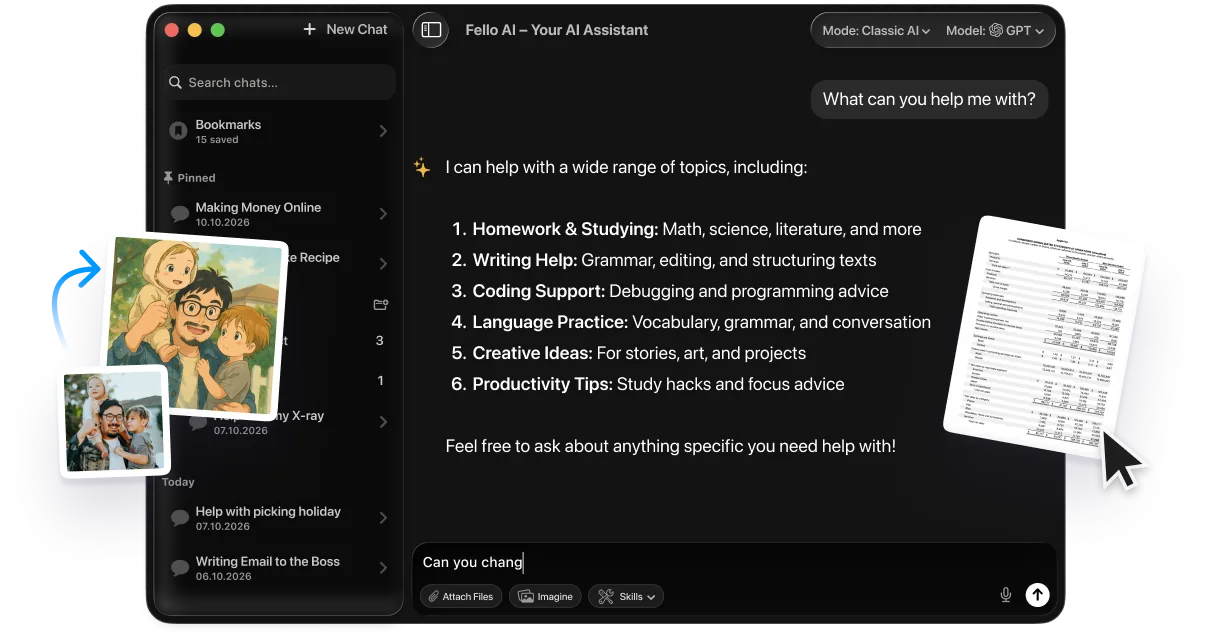
That is the case for keeping more than one model within reach. Fello AI takes that approach on Mac and iPhone, putting ChatGPT, Claude, Gemini, Grok and DeepSeek behind a single app. You move between them as they rise and fall, rather than being tied to whichever one your phone shipped with.
It also generates what you actually need to produce, including images, documents, presentations and spreadsheets. If you would rather weigh the options first, we keep a running guide to multi-model AI apps for Mac.
What to Watch Next
Apple sues OpenAI is a headline about hardware, not about your phone. Nothing has been removed from iOS, Siri runs on Google and Apple’s own models regardless of how this ends, and both companies were already heading for a fight. The allegations are serious and entirely unproven, and OpenAI has denied them in full.
The date worth marking is now 1 October 2026, and it carries more weight than it did a week ago. Judge Davila hears Apple’s injunction motion and OpenAI’s motion to dismiss on the same morning, so the case could be bound tight or thrown out on the same day, comfortably ahead of the hardware launch OpenAI expects before the end of the year.
Three smaller dates tell you how it is going. 17 August brings OpenAI’s response to the injunction, 19 August brings Apple’s answer to the motion to dismiss, and 24 August starts the replies. Those briefs will be the first time either side argues the merits to the judge rather than to the press.
Do not panic about ChatGPT vanishing from your iPhone, because it is not going anywhere this week. Just make sure your own setup does not depend on any of these companies staying friendly with each other.
FAQ
Why is Apple suing OpenAI?
Apple filed suit on 10 July 2026 in the Northern District of California, alleging OpenAI systematically stole its trade secrets to build a rival AI device. The complaint names OpenAI, its io Products hardware unit, Chief Hardware Officer Tang Tan and former engineer Chang Liu, and claims the theft ran “at every level”. OpenAI denies the allegations.
Will ChatGPT be removed from the iPhone?
No. As of publication ChatGPT is still integrated into iOS, including as a Siri fallback for knowledge questions and inside Writing Tools, Image Playground and Visual Intelligence. The lawsuit targets OpenAI’s hardware programme, not the software integration on your device, and Apple has not announced any change to it.
What AI actually powers Siri now?
Siri runs on Apple’s own on-device and Private Cloud Compute Foundation Models, working alongside a Google Gemini model under a multi-year, non-exclusive deal announced on 12 January 2026. It has been reported at around $1 billion a year, though neither company has confirmed the figure. ChatGPT is an optional add-on, not Siri’s engine.
Is Jony Ive named in Apple’s lawsuit?
No. His company io Products, which OpenAI bought for more than $6 billion, is a named defendant, but Ive himself is not. The individuals named are Tang Tan, a 24-year Apple veteran who is now OpenAI’s Chief Hardware Officer, and Chang Liu, a former Apple engineer of eight years.
Was OpenAI also planning to sue Apple?
Yes. Bloomberg reported in May 2026 that OpenAI was weighing legal action against Apple over the Siri partnership, including a breach-of-contract notice, after concluding the deal had failed to deliver the integration and subscription revenue it expected. One executive said Apple had not “even made an honest effort”. Apple filed first.
What is Apple asking the court to do?
Apple moved on 3 August 2026 for a preliminary injunction barring two former employees and OpenAI from accessing, acquiring, using or disclosing its confidential information while the case runs, plus expedited discovery covering documents and depositions. Judge Edward J. Davila has set the hearing for 1 October 2026 in San Jose, with responses due by 17 August and replies by 24 August 2026.