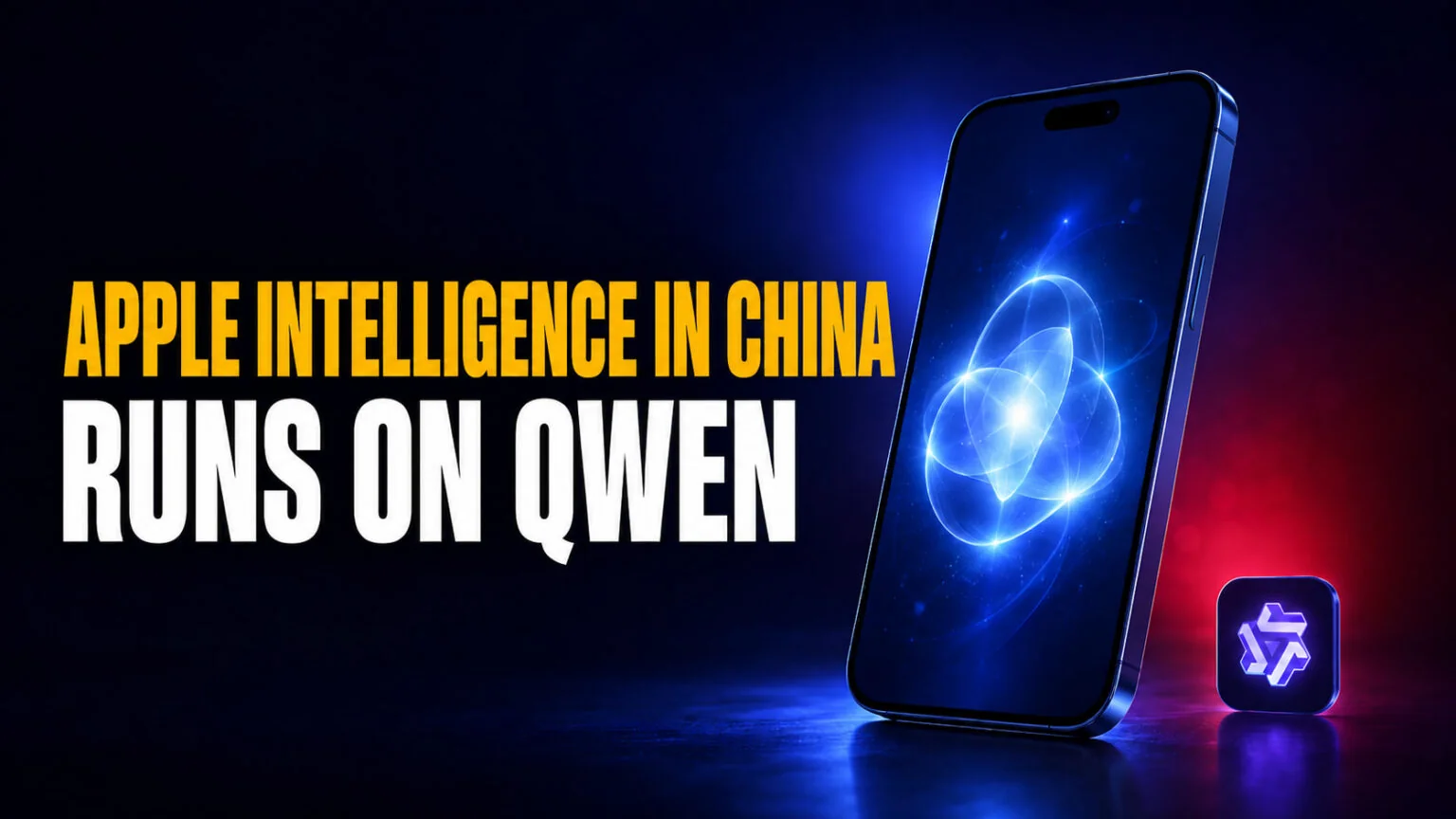
On July 15, 2026, China’s Cyberspace Administration approved Apple Intelligence for the country, and the model doing the heavy lifting is not ChatGPT. It is Alibaba’s Qwen, which will power Apple’s on-device AI features across iPhone, iPad, Mac, and Vision Pro for users in mainland China. This is the first time Apple Intelligence in China becomes a real product, after the whole suite sat locked out of the market since its global launch in late 2024.
The deal matters far beyond one regulatory sign-off. It confirms something FelloAI readers already know from watching the model wars, which is that the AI powering your device now depends on where you live. This article breaks down exactly what Apple got approved, why it chose Qwen over ChatGPT, which other Chinese labs were in the running, when Chinese users can expect it, and what the whole arrangement means for you no matter which country you are in.
The Key Takeaways
- Alibaba’s Qwen will power Apple Intelligence in China across iOS, iPadOS, macOS, and visionOS, approved by China’s Cyberspace Administration on July 15, 2026.
- Apple picked Qwen because ChatGPT is blocked in mainland China, so it needed a licensed local model to fill the same slot.
- Baidu is also confirmed to be building Apple Intelligence features for China, and Apple reportedly weighed DeepSeek and ByteDance before settling on Alibaba.
- No launch date is set, but approval usually precedes rollout by a few months, pointing to the fall 2026 iOS 27 window.
- Greater China brought Apple $20.5 billion in Q2, up 28% year over year, and Alibaba’s US-listed shares rose about 4% on the news.
What Apple Just Got Approved in China
China’s Cyberspace Administration, the country’s top internet regulator, cleared Apple’s AI services on the back of a deal to integrate Alibaba’s Qwen model directly into Apple’s operating systems. According to TechCrunch’s report on the approval, Qwen will run inside iOS, iPadOS, macOS, and visionOS for users in mainland China. That covers the iPhone, iPad, Mac, and Vision Pro, which is the same device spread Apple Intelligence already serves everywhere else.
The practical effect is that Chinese users get Qwen’s text and image capabilities from inside Apple’s own interface, without jumping to a separate app. It works much like the way Apple Intelligence hands certain requests to ChatGPT in other regions, except here the world-knowledge engine underneath is Alibaba’s. A Baidu spokesperson separately confirmed the company is also working with Apple on Apple Intelligence features for Chinese users, so this is a multi-partner arrangement rather than a single vendor lock.
This clears a block that had stood since Apple Intelligence launched globally in late 2024. Chinese iPhones shipped with the hardware but none of the generative features, a gap that grew embarrassing as local brands raced ahead on AI. Apple even accidentally activated some features for a slice of Chinese users back in March 2026, months before this official clearance, which hinted the plumbing was already in place and waiting on regulators.
Why Qwen and Not ChatGPT
The short answer is regulation. ChatGPT is not available in mainland China, and foreign large language models cannot legally serve Chinese consumers without going through the country’s approval regime. Every generative AI model offered to the public in China must be registered and cleared by the Cyberspace Administration, and OpenAI’s models are not on that list. If Apple wanted Apple Intelligence to work in China at all, it had no choice but to partner with a licensed domestic lab. The wider relationship has since collapsed, and Apple is suing OpenAI over alleged trade secret theft in California.
A licensed local model was the only path
Alibaba’s Qwen family is one of China’s most capable and widely deployed model lines, and it already carries the regulatory approvals Apple needed. Choosing it lets Apple ship the same feature set, chat, writing tools, and image generation, while staying inside Chinese law. For a market that generated Apple $20.5 billion in a single quarter, walking away was never a serious option. Alibaba has since pushed further upmarket with Qwen 3.8, its 2.4-trillion-parameter multimodal flagship.
Apple likely keeps its own layer separate
Apple’s on-device Foundation Models and its Private Cloud Compute system are the parts it markets as the privacy backbone of Apple Intelligence. Analysts expect Apple to keep that layer under its own control and route only the broader world-knowledge and generation requests to Qwen, similar to how ChatGPT sits as an optional bolt-on elsewhere. That split has not been spelled out in full by Apple, so treat the exact boundary as an informed expectation rather than a confirmed spec.
The Models Apple Considered
Alibaba was not the only candidate. Apple reportedly talked to several Chinese labs before landing on Qwen, passing over some for scale reasons and keeping Baidu involved as a secondary partner even after picking Alibaba as the primary model. Here is how the shortlist stacked up.
| Company | Model | Role in the deal | Status |
|---|---|---|---|
| Alibaba | Qwen | Primary model powering Apple Intelligence in China | Confirmed and approved |
| Baidu | Ernie | Secondary partner building China-specific features | Confirmed by Baidu |
| DeepSeek | DeepSeek | Evaluated as a candidate | Reportedly considered, not chosen |
| ByteDance | Doubao | Evaluated as a candidate | Reportedly considered, not chosen |
The pattern is telling. Apple did not want a single point of dependence, so it anchored on Qwen while keeping Baidu involved, a hedge that mirrors how Apple manages chip and component suppliers. Qwen is also an open-weight model line in many of its releases, which gives Apple more control over how it deploys and tunes the system than a fully closed foreign API would.
When Will Apple Intelligence Launch in China?
Apple has not announced a firm date for the China rollout. As MacRumors reports, no launch date has been given, and approval typically precedes a rollout by only a few months. That timing lines up neatly with Apple’s usual fall software cycle, so the most likely window is the iOS 27 and macOS 27 release later in 2026.
The upgraded Siri and the wider Apple Intelligence feature set are already testable elsewhere through the public beta, which you can read about in our guide to the iOS 27 public beta and new Siri. China is expected to get its own version of that same experience, tuned to run on Qwen and to comply with local content rules. Until Apple confirms a date, treat any specific month as an estimate rather than a promise.
What This Means for You
The impact splits sharply by where you are. For Chinese users the change is direct and imminent, while for everyone else the story is about the precedent Apple just set. Here is how it breaks down.
If you are in China
You are about to get Apple Intelligence for the first time, powered by a model built and hosted in China. That means the writing tools, summaries, and image features arrive on your iPhone and Mac, but the answers come filtered through Qwen and Chinese content rules rather than the model Apple uses abroad. Expect the feature names to match the global version while the behavior and boundaries differ.
If you are anywhere else
Nothing changes for your device today, but the precedent is the real story. Apple has now shown that the intelligence behind your assistant is swappable and set by region, not a single fixed brain. The same request goes to ChatGPT in one country and Qwen in another, and you as the user rarely get a say in which one runs.
That is exactly why so many people no longer rely on a single built-in assistant. If Apple can route your queries to whichever model fits its business and legal situation, you can do the opposite and choose the model that fits your task. Our breakdown of Apple Intelligence alternatives for Mac walks through how to keep that control in your own hands.
The Bigger Picture: One Region, One Model
The China deal is a clean illustration of where consumer AI is heading. Platform owners increasingly bind you to whichever model suits their deals, their compliance needs, and their geography. Siri on a Chinese iPhone will think in Qwen, Siri elsewhere leans on Apple’s own models plus ChatGPT, and you inherit whatever the platform decided. If that trade-off bothers you, our comparison of Siri versus ChatGPT shows how far the built-in option still trails a dedicated AI app.
The alternative is a multi-model setup where you pick the engine per job. FelloAI takes that approach, letting you reach many leading models from one app on your Mac and iPhone, so a coding question, a writing task, and an image prompt can each go to the model that handles it best. You can compare the current field on our regularly updated best AI models hub and decide for yourself rather than accepting the one your region assigns. Model choice, in other words, does not have to depend on your passport.
Conclusion
Apple Intelligence in China is finally real, and it runs on Alibaba’s Qwen because a licensed local model was the only way through China’s rules. Watch the fall 2026 iOS 27 window for the actual launch, and expect Baidu to stay in the picture as a second partner. The lasting lesson is simple, which is that the model behind your assistant is now a business and legal decision made above your head. If you would rather make that decision yourself, a multi-model app like FelloAI lets you pick the best AI for each task instead of taking whatever your region ships.
FAQ
What AI model powers Apple Intelligence in China?
Alibaba’s Qwen is the primary model, running across iOS, iPadOS, macOS, and visionOS for users in mainland China. Baidu is also confirmed to be building Apple Intelligence features as a secondary partner.
Why does Apple use Qwen instead of ChatGPT in China?
ChatGPT is not available in mainland China, and foreign models cannot legally serve Chinese consumers without regulatory approval. Apple needed a licensed local model, and Alibaba’s Qwen was already cleared by China’s Cyberspace Administration.
When will Apple Intelligence launch in China?
Apple has not announced a firm date. Regulatory approval usually comes a few months before a public rollout, which points to the fall 2026 iOS 27 and macOS 27 window as the most likely launch period.
Will Apple Intelligence in China be different from the global version?
The feature names and interface should match, but the answers will come from Qwen and follow Chinese content rules rather than the models Apple uses elsewhere. Expect the same tools with different underlying behavior and boundaries.
Can I choose a different AI model on my iPhone or Mac?
Yes. A multi-model app like FelloAI lets you reach many leading models from one place and pick the best one for each task, instead of relying on whichever model your region’s built-in assistant is tied to.